
Bruce A. Vojak1
Abstract
With this manuscript, I honor Phil Mullins’s broad interests and long career studying the work of Michael Polanyi. I begin by summarizing my career-long exploration of rare individuals who display great expertise in tacit knowing: Serial Innovators, organizational powerhouses who solve consumer problems and substantially contribute to the financial value of their firms. By noting their existence, characteristics, and practices here, I hope to engage in discussion with Polanyians interested in exploring connections between what I have observed and their understanding of Michael Polanyi’s insights. To help frame these potential conversations, I also share how the business literature has, to date, failed to understand correctly and, as a result, apply Polanyi’s insights accurately. I conclude by engaging with some of Phil Mullins’s publications, illustrating the connections I hope to make between my Serial Innovator work and Polanyi’s insights.
Introduction
Already early in my career, a nagging question had slowly, almost imperceptibly crept into my thoughts: “How do they know? How do certain exemplary, respected business innovators know what to do?”
How did Nick know to explore quantum wells, inserting them into their now-pervasive application in semiconductor lasers? How did Steve know he could build a company from a product that Motorola was unsuccessful in developing? How did Nancy know how to transform a failing product into a billion-dollar brand?
How?
Such was the question that ultimately brought me into contact with Polanyians in general and Phil Mullins in particular.
By 1999—already two decades into my career—I had transitioned from industry into an academic environment, serving as an Associate Dean and Adjunct Professor in the Grainger College of Engineering at the University of Illinois at Urbana-Champaign. Now, I had the opportunity to pursue my question formally. I initiated research in the field of engineering management, exploring what seemed so obvious to me to ask: “How do they know?”
My studies began simply, first by speaking with former colleagues about their experiences and then by conducting large-sample surveys of engineers and scientists in industry. As this research stream developed, I began collaborations with those possessing complementary expertise, first with a colleague expert in organizational behavior (Ray Price) and later adding a colleague expert in marketing (Abbie Griffin), both of whom also had prior industry experience in addition to their then-current academic roles. Together, Abbie, Ray, and I conducted a decade-long, pioneering study of those we ultimately referred to as Serial Innovators, “individuals who have conceived ideas that solve important problems for people and organizations, have developed those ideas into breakthrough new products and services, inventing new technologies to do so as needed, and then have guided those products and services through the corporation’s commercialization process and into the market” (Griffin, Price, and Vojak 2012).
Through a series of peer-reviewed journal articles and conference presentations, a few book chapters (Vojak, Price, and Griffin 2010; Vojak and Price 2014; Vojak 2017), and the book Serial Innovators: How Individuals Create and Deliver Breakthrough Innovations in Mature Firms (Griffin, Price, and Vojak 2012), we documented and shared who these Serial Innovators are and how they develop novel products, ranging from new electronics to novel feminine hygiene pads in mature companies such as Hewlett-Packard and Procter & Gamble. Based on interviews with over fifty Serial Innovators and an even larger pool of their coworkers, managers, and human resources teams, we revealed key insights about how to better understand, emulate, enable, support, and manage these unique and important individuals for long-term corporate success.
Concurrent with this research stream, yet entirely unrelated,2 I became intrigued to understand who Michael Polanyi was in more detail than the simplistic ‘tacit knowledge’ references I’d seen to that point. So I ordered a few books on Amazon, selected to give me some options to skim, a common practice of mine as I explore a topic new to me. Polanyi’s Personal Knowledge (1958), Drusilla Scott’s Everyman Revisited (1985), and Esther Meek’s Longing to Know (2003) arrived shortly after the start of the new year in January 2007. I found Personal Knowledge unfathomable. Unfortunately, I recall little of Everyman Revisited. But Esther’s book was just right, so I began reading it.
It was then that I was hit by a metaphorical ton of bricks. As I read Esther’s chapter 6, in which she likens the act of knowing to viewing a Magic Eye® image (Magic Eye, Inc. 2018), I realized that what she described was precisely what we had observed in these corporate exemplars, the Serial Innovators, a connection I’d neither sought nor anticipated.
This was the point of departure for my interest in Michael Polanyi’s thought. It led me to initial discussions with Esther and, ultimately, to engage with Polanyi’s work and, later, the Polanyi Society as a whole. My aspiration to work with Polanyians is to bridge and apply the epistemological insights of Polanyi scholars to what I have observed in innovation.
Much of this manuscript is designed to introduce Polanyians to who Serial Innovators are, especially but not limited to how they grasp what to do. The remainder (1) documents the extant literature linking Polanyi’s work with business innovation, (2) briefly summarizes my work in this area, and (3) illustrates how I anticipate dialog with Polanyians might occur by engaging with a few scholarly articles prepared by Phil Mullins, whom we honor here.
Serial Innovators: An Overview
So, who are these Serial Innovators? What does it look like as they come to know what to do? What is the context for my fascination with Polanyi’s insights as they apply to business innovation?
What Is Innovation?
Let’s begin by establishing a shared understanding of what they do: innovate. For some time, I’ve embraced this definition, satisfying due to its clear connection between creativity and the context of real business needs:
Innovation is not “creativity,” nor “something new,” nor “something different” as is too often the response. Innovation also is not “technology,” although technology can play a role. Instead, …innovation is the commercialization or actual productive use, based on creativity, of products, processes, services, or business models—commercial use with financial impact. It is the reduction to practice of creativity. If it’s not in the market or public use, it is not innovation addressing a user’s needs. (Vojak and Herbst 2022)
Working within this definition, I’ve found two subcategories helpful when discussing innovation, incremental and breakthrough, illustrated by the progression of carrot-peeling solutions depicted by a series of paradigms in Figure 1 (Vojak and Herbst 2022).
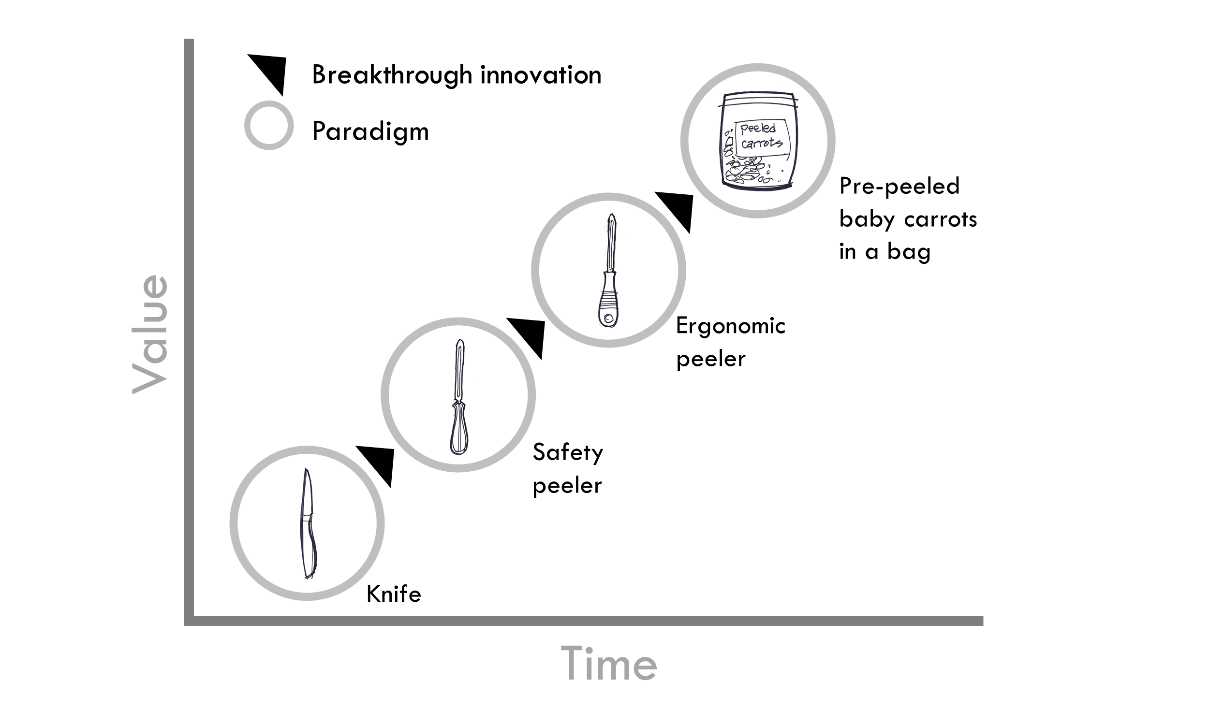
A paradigm in this context is understood to be a generally constant approach to addressing customer needs. When an industry embraces a paradigm, the basis of competition within that industry is reasonably stable. During this period, competitors incrementally make the then-current product better. In this example, competitors improved safety peelers by migrating to the most straightforward manufacturing designs and reducing material costs. Yet, when a competitor identifies a new, breakthrough way to address the same need—Sam Farber introducing the ergonomic peeler or Mike Yurosek introducing pre-peeled ‘baby’ carrots—they propel the industry forward into new paradigms. They change the basis of competition, placing their companies in relatively sustained leadership positions for financial and strategic success compared to those left behind. In this example, companies that still only produce simple safety peelers now compete solely on the basis of cost.
A Process View of Innovation
The most commonly embraced view of contemporary innovation accepts that two very different, complementary processes exist in series. Figure 2 illustrates a creative, divergent ‘front end’ followed by an implementation, convergent ‘back end.’
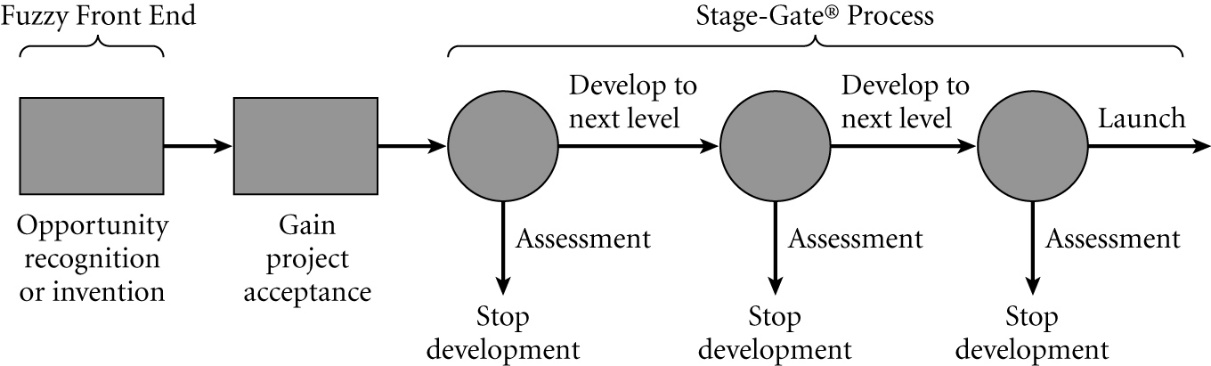
The front end of innovation carries the unarticulated assumption that we cannot fully grasp how innovation occurs; the ‘Fuzzy Front End’ (FFE) is an example of such a perspective. Such a ‘fuzzy’ view of innovation appropriately opens up possibilities for the volatility, uncertainty, complexity, and ambiguity that characterize breakthrough innovation. When practitioners, popular authors, and academics illustrate it this way, their unarticulated assumption is that we do not grasp much about the specifics of what occurs in the FFE.
The back end of innovation carries with it the unarticulated assumption that we can systematically evaluate and develop promising innovative concepts, that is, reasonably grasp how to proceed with innovation; the Stage-Gate® Process (SGP) is an example of such a perspective. Such a process view of innovation appropriately systematizes innovation activities in ways that characterize how most other, non-innovation processes in the firm work.
Risking oversimplification, the FFE suggests epistemological skepticism, while the SGP, in contrast, suggests something like epistemological certainty. Together, they form a process that many senior executives (think ‘Pointy-Haired Bosses’) regularly seek to manage as a lifeless machine—an impersonal view emerging over time from the scientific approach to management of the type advanced by the likes of Frederick Taylor and Frank Gilbreth at the onset of the twentieth century—as they ignore the FFE’s complex essence. All the while, the most proficient of those tasked with implementing innovation investment (think ‘Dilbert’) understand there is nothing mechanistic about it.
Serial Innovators: An Exemplar
Reframing innovation by focusing on the people who create it rather than the processes by which it is (or, more accurately, “is speculated by many to be”) created reveals new and important insight into how companies successfully renew their business. We can begin to contrast a process view of innovation with a people view by sharing a bit of the story of an innovation exemplar, Tom Osborn.
Tom Osborn was a Serial Innovator who had significant impact on the feminine hygiene product industry during his career at Procter & Gamble. When he began in this industry, the generally held perspective was that the purpose of a feminine hygiene product was merely to catch fluid, similarly to the way in which a diaper performs, and the goal of innovation was to improve performance within this diaper paradigm. Tom, however, sought to understand the problem in a deeper, more nuanced way. He did so through various methods, such as working with medical models, reconsidering commonly held assumptions, testing prototypes, and constantly iterating. In doing so, he realized that he needed to reframe the problem, from a diaper to a garment paradigm—that is, a paradigm in which the product behaved like a garment, yielding a more comfortable fit while still performing as required. This reframing, he believed, could provide great benefit to P&G’s customers and shareholders, as well as to his coworkers and management. While he nearly lost his job in the process, Tom was able to navigate his organization effectively, ultimately gaining strong management advocacy, resulting in a breakthrough innovative product, Always Ultra, now one of P&G’s billion-dollar brands. In recognition of his contributions, Tom was inducted into P&G’s Victor Mills Society, the highest technical-ladder level and honor in the company. (Vojak, Price, and Griffin 2012)
Serial Innovators: How They Engage
What differentiates Serial Innovators from the rest besides a repeated, significant financial impact on their company? How might we successfully identify them?
Serial Innovators display the following characteristics:
• How they engage with problems. Serial Innovators actively engage problems. They are exceptionally curious as they seek to understand a challenge they are confronted with, seeking deep and broad insight and asking tough yet appropriate questions. As they gather clues, Serial Innovators begin to seek patterns in the data. In this way, they are holistic, systems thinkers. In the process, they display above-average creativity in their thinking, not willing to rest in the first or most convenient interpretation of the problem.
• How they engage with projects. Once engaged on a project, Serial Innovators are tenacious. Unlike those who are easily discouraged, Serial Innovators see projects through to completion. This tenacity may merely involve testing hypotheses that ultimately are not worth pursuing. Yet these individuals stand out in their willingness to try the idea, rather than speculating an outcome and resigning themselves to it. A prime example of such behavior is their deeply probing both articulated and unarticulated customer needs. Serial Innovators do not rely on guesswork when customer engagement or a simple experiment provides unrefutable insight.
• How they engage with business. In contrast with those who are merely creators or inventors, Serial Innovators understand the need to bring ideas to market successfully. This is more a distinctive characteristic in large, mature companies where many become isolated from the market rather than in small- and medium-sized mature enterprises where limited resources rarely allow this possibility.
• How they engage with people. Unlike the commonly held stereotype of the lone, socially awkward inventor, Serial Innovators value people. They see the strengths in others and value and enlist them to help accomplish the company’s strategic goals. By establishing a reputation based on trust and respect, Serial Innovators use informal leadership skills to bring others along with them in ways rarely seen. Because they are self-motivated to solve customer problems, Serial Innovators accept responsibility to make things happen. They do so by possessing a willingness and developing the necessary skill to influence and convince others as they seek to create value.
Note that it is the complete set of these distinctive characteristics that make Serial Innovators so powerful. The absence of one or more reduces the aspiring Serial Innovator’s effectiveness as they will be unable to effect the type of change necessary for the company to succeed at renewal. (Vojak and Herbst 2022)
Serial Innovators: The Hourglass Model
Carrying this discussion to a next level, and building on my earlier discussion of the SGP, Serial Innovators traverse a path illustrated by the Hourglass Model of Figure 3 (Griffin, Price, and Vojak 2012) while simultaneously satisfying management’s need for linear structure by working within a SGP.
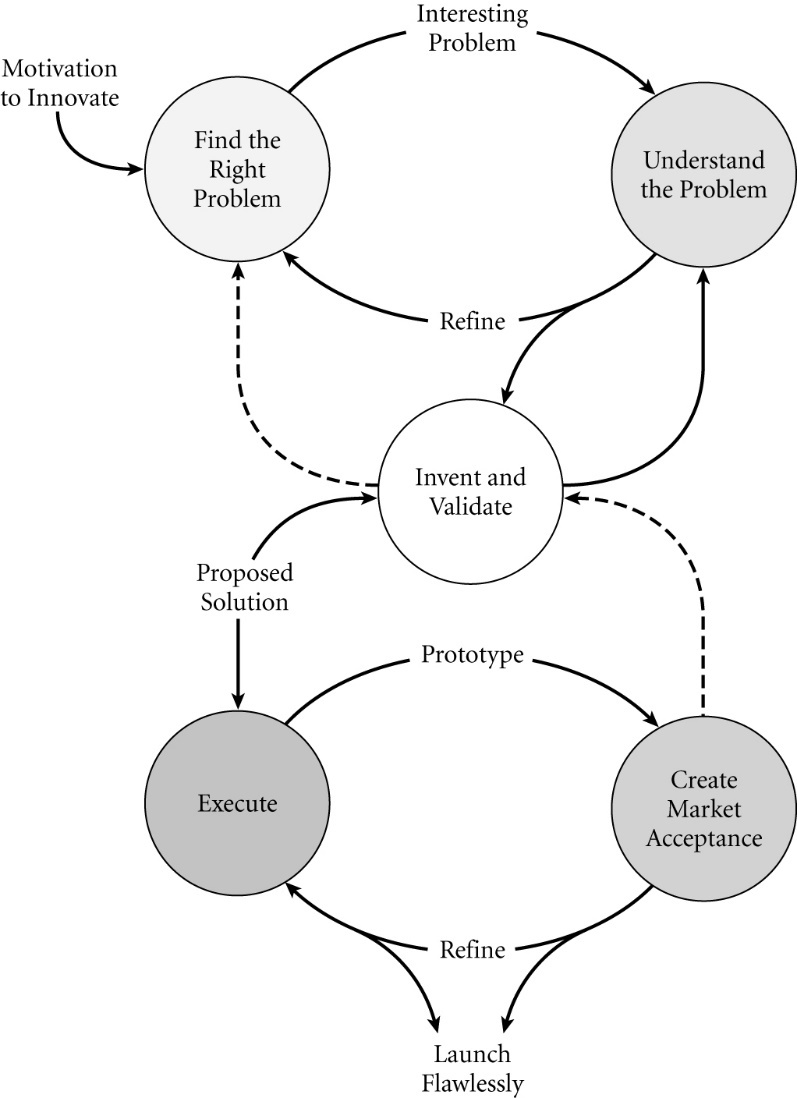
Serial Innovators begin at the upper left of the Hourglass Model, self-motivated to innovate. After finding a problem worthy of their effort, they follow their curiosity to understand it deeply and broadly. They intimately grasp customer needs, competitive positions, technical possibilities, and manufacturing options, to name a few. Only then do Serial Innovators begin to prototype options and iteratively test them. These upper three activities constitute the front end of innovation, as described in our discussion of the SGP. Solutions deemed to have market potential drop down to the back end of innovation, where Serial Innovators continue engagement as commercialization proceeds through a gated process. While not commonly witnessed in others, such post-invention attention ensures that their innovative insights are not lost after conception. Further, Serial Innovators often appropriately continue their customer and market involvement, begun in the front end, in the back end of innovation, aiding market acceptance.
For the purposes of discussion in this manuscript, the Hourglass Model differs from the SGP in two fundamental ways. First, the Hourglass Model depicts a nonlinear, often recursive flow of activity, contrasting with the SGP’s linear flow. Second, it describes Serial Innovators’ path, contrasting the SGP’s prescriptive use. (Vojak and Herbst 2022)
Serial Innovators: Holistic, Intimate, Nonlinear
As I’ve reflected on how innovators come to know what to do today to have significant future impact, three features of their practice of discovery are plainly apparent. Their observed but often unarticulated epistemology is holistic, intimate, and nonlinear. These features work together in Serial Innovators and represent the ‘posture’ they assume while engaging in innovation.
Holistic. Serial Innovators are systems thinkers, regularly speaking as such in terms of ‘connecting the dots.’ They see subtle, embedded patterns within massive amounts of data and sensory experiences much earlier than others, if not seeing patterns that others simply cannot perceive. Further, they often see and frame problems, as well as solutions, in new ways that others do not. In a world often dominated by disciplinary experts, Serial Innovators easily span multiple disciplines, integrating insights across them in new and unique ways.
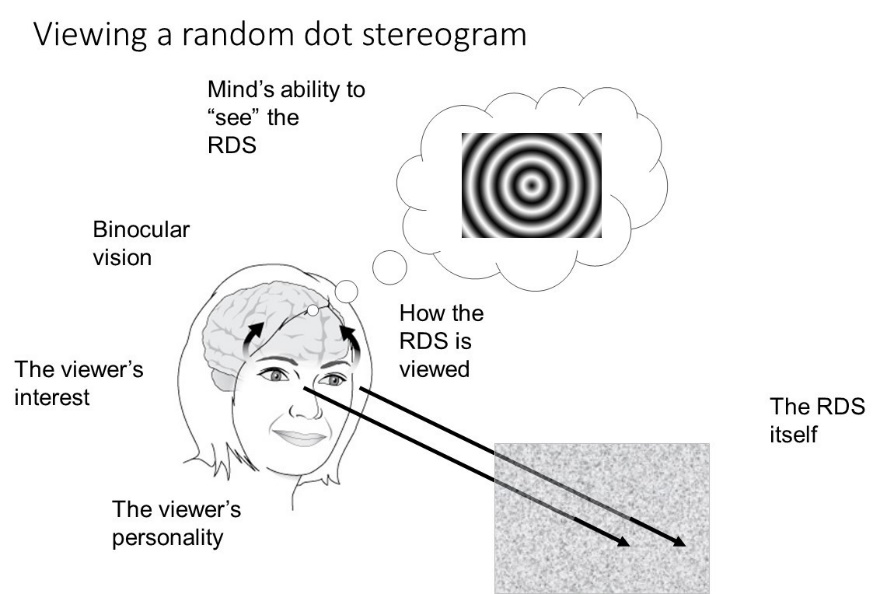
As alluded to earlier and illustrated in Figures 4 and 5, we can use the act of viewing a Magic Eye® image (also known as a Random Dot Stereogram, RDS) as a metaphor for the discovery—the emerging awareness of breakthrough insight—characteristic of Serial Innovators (Vojak, Price, and Griffin 2010). While length limitations preclude discussing these two images in detail here, this metaphor is powerful, and much more can be illustrated than merely depicting Serial Innovators’ ‘connecting the dots’ in their practice of innovation.
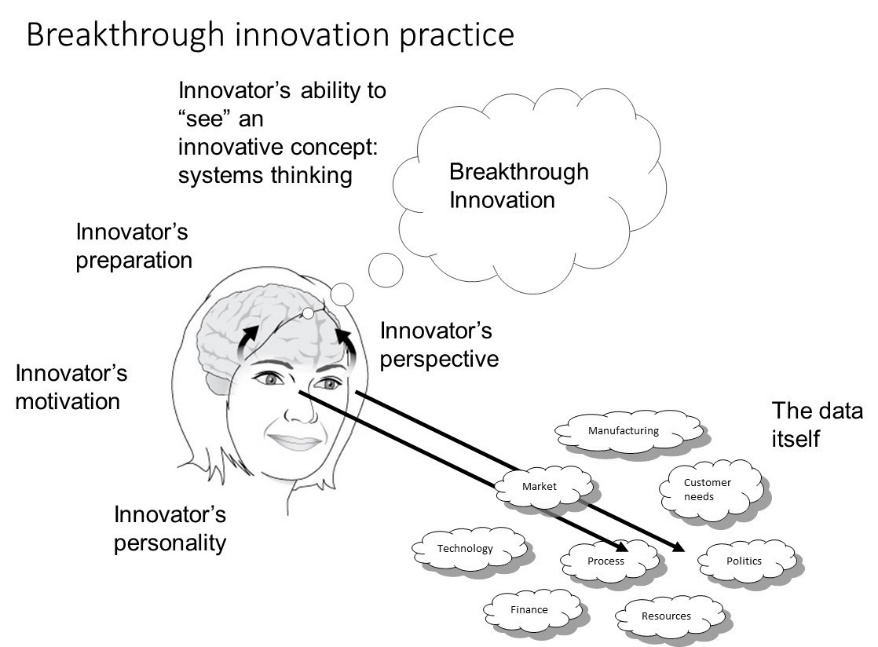
Intimate. In contrast to those who advocate free-wheeling brainstorming as a means to innovate, Serial Innovators immerse themselves deeply in the lives of those they serve, the problems they seek to solve, and the needs of those in their organizations. Such intimacy regularly leads to identifying, understanding, and challenging unarticulated assumptions and, as a result, gaining new innovative insight not otherwise accessed. To illustrate this, I share here additional details about Tom Osborn, the Procter & Gamble Serial Innovator whose story we used to introduce the concept of a Serial Innovator earlier in this manuscript. Notably, his intimate engagement with the then-current problem, his colleagues, external experts, and potential customers led him to reframe the company’s and industry’s existing understanding of the problem (optimize a feminine hygiene product modeled as a diaper) to a new, more customer-focused and financially attractive problem (optimize a feminine hygiene product modeled as a garment).
Tom’s methods were a radical shift from the ways the product development group had approached research in the past. The fluid the team had been using to test prototypes bore little similarity to menstrual blood. Tom changed the testing and testing protocols to a blood-based substance, and that was just the beginning. He also analyzed wear and flow patterns on thousands of used pads, personally examining hundreds of pads himself. And he realized that, because the FDA classified pads as medical devices, many of the clinical methodologies used in medical device development could be applied to pad research. By building relationships with physicians and staff at a nearby medical school, he was able to investigate the physical and psychological aspects of menstruation, and to develop methodologies to learn how pads interact with and move on a woman’s panty as she moves. The more he learned, the more he doubted the veracity of the prevailing model.
Tom knew that most of his product development colleagues came to Feminine Care from P&G’s diaper category. He understood why their mental model of menstruation was, unconsciously, an extrapolation of learning based on diapers. He also understood why they thought of the pad as something that needed to capture and contain a thin, free flowing stream of fluid. Tom’s research showed that menstrual fluid was, in reality, a viscous fluid that was thicker than urine, and that it left the body slowly, through a combination of small drops and intermittent surges. He began to formulate a model built around a series of thicker drops being pulled from the body by gravity, drops that needed to be pulled into an interior absorptive pad core.
Through his research Tom became convinced that, in women’s minds, product performance was about more than just leakage protection, which could be achieved simply by making the product bigger. Indeed, the approximate menstrual pad size at that time was 1-inch thick by 2.5 inches wide by 6-8 inches long. Tom’s extensive direct-user research indicated that women also wanted comfort, and that pads of the day were anything but comfortable. Women often described the experience as “wearing a brick.”
Tom’s medical school investigations showed that pad comfort included two aspects: thinness and flexibility. Even if P&G had been focused on comfort, it would have been difficult to achieve using the current technology platform, in which comfort improvements came at the expense of protection. The first Always® product was now in the market and, while superior to competitive products, was designed strictly for leakage protection. It was not comfortable. Tom now was certain that the design basis was fundamentally flawed.
He also was convinced that he could invent a pad that would help women get through their monthly periods with increased confidence and ease. Using his new mental model, he began to visualize this pad, not as an absorbent brick, but as a replaceable panty-crotch—a smaller, softer, thinner, and more flexible panty “liner.” The pad Tom imagined would behave as a garment. (Griffin, Price, and Vojak 2012)
Nonlinear. Not only is Serial Innovator discovery characterized by holistic and intimate behaviors, but it also exhibits properties found in nonlinear systems in at least four ways.
First, as noted earlier in my discussion of the Hourglass Model, Serial Innovators traverse a highly nonlinear, recursive path in their pursuit of innovation. Of note, many of the most significant breakthrough innovations only emerge after the original problem has been reframed.
Second, breakthrough innovation exhibits extreme sensitivity to seemingly inconsequential conditions. Two otherwise identical competing companies or innovators often yield remarkably disparate results, regularly the difference between success and failure.
Third, we find a subtle but powerful illustration of the nonlinear nature of breakthrough innovation in the language of patent law, where simple combinations of existing ideas do not qualify for legal protection. Innovation is not merely a linear combination of ideas. Instead, it nonlinearly propels companies into new dimensions.
Fourth and finally, breakthrough innovations are emergent in that they seem to appear out of nowhere, with few or no hints for the vast majority to anticipate them.
Based on such observations, I refer to breakthrough innovation using the language of mathematics: chaotic but not random. Serial Innovators seek the technical, market, customer, manufacturing, and financial equivalent of the boundary of the Mandelbrot set. As a proven Serial Innovator once shared, “Serial Innovators work at the hairy edge of chaos.”
So What’s the Big Idea?
If our awareness of these three salient features of Serial Innovator epistemology wasn’t enough, there is significance in the fact that they exist together—this is no accident.
As noted in Table I, these characteristics are collectively in direct opposition to the type of problem-solving that emerged at the time of the Enlightenment and has dominated Modern thinking since (Vojak 2017). The Enlightenment paved the way for Modernity as well as the significant scientific and technological progress associated with it. While it may be heretical to suggest this to Polanyians, were it not for the Enlightenment, the Modern Era, and this way of thinking, we likely would not have benefitted from the tremendous economic progress—both wealth creation and an improved standard of living—experienced during the Industrial Revolution.
| Modern / Enlightenment | Breakthrough innovation | |
| Reductionist | ↔ | Holistic |
| Detached | ↔ | Intimate |
| Linear | ↔ | Nonlinear |
Table I (from Vojak 2017)
Yet I’m saying here that the best innovators describe their acts of breakthrough innovation as being characterized by a diametrically opposed way of thinking. Although this might appear odd, it represents a powerful aspect of breakthrough innovation.
To get into the game of innovation, one often must be fluent and talented in the reductionist, detached, linear problem-solving methods characteristic of Modern thinking. This is especially true for breakthrough innovation that involves technology in any way, as the best engineers and scientists emerge from their education having powerfully mastered analytic skills characterized by Modern thinking. Yet their skill in Modern thinking is merely their entry ticket, the ante, if you will. Those who truly stand out as innovators have this additional set of skills, the ability to think in this other way. Thus, Serial Innovators represent something of a tiny, highly successful remnant who have not lost this other way of thinking—or, perhaps, have found it—while fully developing in the Modern mode.
Since so few people exhibit great skill in thinking in both these ways, it should not be at all surprising, then, that Serial Innovators are such rare individuals, pathfinders, and visionaries who, by virtue of excellence in these combined discovery skills, along with critical interpersonal skills, lead their companies in exciting new directions.
Serial Innovators: How to Manage Them Effectively
Considering both their unique approach to innovation and their rarity, it should not be surprising that managing Serial Innovators effectively can present considerable challenges to those in executive roles. My colleague, Ray Price, once noted that the only thing more difficult to find than a Serial Innovator is someone who excels at managing them.
Common difficulties include an inability to identify real Serial Innovators—separating these rare metaphorical golden geese from the more abundant poseurs, the wild ducks—and to engage with them in a relational rather than transactional manner. Too meddling or too detached, managers fail in countless ways, often leading to the demotivation of those with the most promise of becoming true Serial Innovators.
While the length constraints of this manuscript prevent me from exploring this topic in detail, readers should not be surprised that a people view of innovation suggests—no, demands—a people view of managing them.
The Relevance of Polanyi’s Insights to Business Innovation
So what do business and innovation scholars and practitioners say about Michael Polanyi? What have I shared to date? Based on how I engage with some of Phil Mullins’s work, what else might be worth pursuing?
A Review of the Business Innovation Literature
Those who have considered the intersection between business on the one hand and philosophy on the other are relatively few. Most commonly, we see discussions of business ethics. Less frequent but salient are reflections on epistemology often discussed as knowledge management.
What, then, of the literature that specifically references Michael Polanyi’s work in the context of business or innovation?
Minimally, it’s problematic.
Misunderstanding and misrepresentation of Polanyi’s work abound. Typical of most of these references is their use of the phrase ‘tacit knowledge’ as a noun, implying a fact or set of facts, rather than submitting to Polanyi’s use of the phrase ‘tacit knowing’ as a verb, denoting the integrative act.
The most significant deviations from Polanyi’s understanding appear in Nonaka and Takeuchi’s The Knowledge-Creating Company: How Japanese Companies Create the Dynamics of Innovation (1995). Nonaka and Takeuchi accurately, albeit briefly, reference Polanyi’s concepts of indwelling and the tacit integration of particulars. Unfortunately, they quickly pivot to suggest that explicit and tacit represent two distinct forms of knowledge that are equal and complementary in footing (missing Polanyi’s insight that all knowledge is either tacit or rooted in tacit and that wholly explicit knowledge is unthinkable; see Polanyi 1969) and can be converted from one to the other (missing Polanyi’s understanding entirely). Underlying this view and consistent with their thinking that the tacit can be converted to explicit, they speak of tacit knowledge in terms of what people know rather than how. This is exemplified in a story shared by Nonaka in an earlier Harvard Business Review article, where he describes how software developer Ikuko Tanaka learned how to make bread (Nonaka 1991). Unfortunately, Nonaka stopped short with his story, as Tanaka only learned a specific recipe. This was what Nonaka described as being converted from tacit to explicit. Nothing suggests that Tanaka mastered the art of baking bread, just that she could learn enough details to replicate what a master had made.
And so there is no missing the significant difference between Nonaka and Takeuchi’s definition and Polanyi’s, consider what Physics Nobel Laureate E. P. Wigner said of Michael Polanyi in his 1963 Nobel Banquet speech:
I can not mention all to whom I am indebted but I do wish to mention the inspiration received from Polanyi. He taught me, among other things, that science begins when a body of phenomena is available which shows some coherence and regularities, that science consists in assimilating these regularities and in creating concepts which permit expressing these regularities in a natural way. He also taught me that it is this method of science rather than the concepts themselves (such as energy) which should be applied to other fields of learning.
Nonaka’s article appearing in Harvard Business Review and Nonaka and Takeuchi’s book published by Oxford University have given their work near unassailable credibility in the business world. Harvard Business Review confirmed this when it reprinted Nonaka’s article in 2007, with the editor sharing,
This 1991 article helped popularize the notion of “tacit” knowledge—the valuable and highly subjective insights and intuitions that are difficult to capture and share because people carry them in their heads. Years later, the piece can still startle a reader with its views of organizations and of the types of knowledge that inform them. (Editor 2007)
The tacit, then, is regularly used in the knowledge management literature to refer to specific recipes or techniques rather than the broader mastery, the skillful art of knowing that Polanyi describes. As a Polanyian might imagine, this leads to all types of misleading statements that do not stand up in the light of Polanyi’s work. Most importantly, such widely accepted statements stand in the way of a more fruitful application of Polanyi’s work.
My Work to Date
I have never formally studied philosophy. While grasping some sense of philosophical history and developing reasonable epistemological insights through self-study, I lack the mastery and fluency of those steeped in them. Instead, as demonstrated earlier in this manuscript, I bring a broad and deep understanding of Serial Innovators and breakthrough innovation in industry to what I see as actual and potential connections with Michael Polanyi’s insights.
So where have I gone with this?
Despite framing the act of innovation in terms of the innovator’s mastery and posture (holistic, intimate, and nonlinear, as discussed earlier), as these ideas are more accessible or familiar to most in the innovation field, I believe I have remained faithful to Polanyi’s insights regarding indwelling and from-to tacit integration (Vojak, Price, and Griffin 2010; Vojak and Price 2014; Vojak 2017).
Further, I have developed numerous ways to illustrate and demonstrate these ideas to industrial workshop participants and clients as a means of helping them grow as innovators. These include showing videos of a world master multiple kite flyer at work, sharing stories of sticking my hand into a cow’s stomach and eating a candy cane, constructing a stand to display two double pendulums simultaneously, and challenging participants and clients to read and recall a list of words both in and out of context.
While I believe I’ve done well, I still would like to explore and understand—in dialog with Polanyians—what other of Michael Polanyi’s insights might be relevant and impactful to share with the business and innovation communities.
Applying Phil Mullins’s Insights on Michael Polanyi to Business Innovation
To illustrate the type of connections I aspire to make between my Serial Innovator work and Polanyi’s insights, I’ve used the preparation of this manuscript to engage with a few of Phil Mullins’s papers (C. P. Mullins 2019). Here, I share a series of brief observations and connections I have found particularly interesting regarding Phil’s Polanyi-informed engagement with the fiduciary dimension, what to believe, Gestalt psychology, and artificial intelligence.
The Fiduciary Dimension. While already familiar with the idea of ‘believing in order to know’—attributed in earlier, various forms to Augustine and Anselm, as well as embraced by Polanyi—I was particularly struck by Mullins and Jacobs’s discussion of Polanyi’s understanding of the fiduciary dimension (Mullins and Jacobs 2018).
First, I identified specifically with their mentioning of the pattern: “The child cannot learn to speak unless it accepts on faith that the sounds heard are significant.”
This reminded me of a conversation I witnessed between my thesis advisor (inventor of the visible light-emitting diode Nick Holonyak Jr.) and his former thesis advisor (two-time Physics Nobel Laureate and inventor of the transistor John Bardeen). Holonayk was almost childlike—so there is no misunderstanding, I intend this as a compliment—in his reverence for Bardeen as a person, the historic nature of Bardeen’s contributions, and Bardeen’s great insight. Upon Bardeen, in from my experience his almost painfully quiet way, uttering the simple statement, “there’s something there,” while viewing recent experimental results, Nick was moved to action. He implicitly trusted Bardeen’s words and took them as meaning that there was something unique and undoubtedly worth pursuing, which he did and which led to unexpected and significant new insights (Holonyak et al. 1980).
Second, I also resonated with Mullins and Jacobs’s mentioning that “Polanyi noted that faith underlies scientists’ decisions on which experiments to conduct, and it may take them ‘a lifelong practice of devotion’ for the results of an experiment to become manifest” (Mullins and Jacobs 2018). This statement reminded me of two illustrative stories.
The first is that of entrepreneur Steve McShane, who informally shared with a friend the simple observation, “I think I can make a company out of this,” when describing a product line he considered acquiring from Motorola, which wanted to divest it as the company had been unable to succeed with it. After doing so, Steve persisted nearly a decade before the product and the company he founded based on it, Midtronics, succeeded in ways others would not have predicted and that would not have occurred without Steve’s insightful and faithful tenacity (Vojak and Herbst 2022).
The second is the story of Serial Innovator Nancy Dawes, responsible for renewing a failing Oil of Olay brand into the now billion-dollar-brand Olay (Vojak and Herbst 2022). Once, during an informal lunch, while still early in my reflections on the epistemology of innovation, I asked Nancy how she knew what to do. Her response? “I see dead people.” Not yet having seen M. Night Shyamalan’s The Sixth Sense (1999), it is an understatement to say that I was taken aback. Yet, as she explained further, she shared how she saw—and over time accepted the fact that she saw—patterns that others did not. Such unarticulated insight motivated her to persevere where others might not.
What to Believe. Building on this idea of the fiduciary dimension, I found Polanyi’s brief piece “What to Believe” (2020) and Phil’s discussion of it (2020) helpful, intriguing, and relevant.
Most important in these articles is how Polanyi extends the joint, three-fold idea of understanding, believing, and belonging working together beyond his reflections on science to other situations, in this instance, religion in general and Christian faith in particular. In the case of business innovation, those with expertise in engineering/technology, marketing, manufacturing, finance, and numerous other backgrounds come together in a milieu united in goal (financial success) yet divided by approach (disciplinary expertise). Members of each discipline “know” how best to succeed financially and strategically. They (1) understand the world in different terms (STEM expertise, customer needs, operational effectiveness, and quantifiable measures), (2) believe that their discipline has the most effective way to succeed, and (3) belong to distinct and separate professions. In contrast, Serial Innovators successfully bridge these multiple perspectives so that their distinctions vanish in favor of a holistic understanding of the problem and the means to solve it.
Gestalt Psychology. While already familiar with Polanyi’s embrace of Gestalt psychology, as illustrated by my reception of Esther Meeks’s use of Magic Eye® images to illustrate it, I was particularly taken by aspects of Phil’s discussion of Polanyi’s use of it (2010).
First, I was taken by Phil’s contrasting two kinds of order, externally imposed order vs. self-ordering, illustrated by using the metaphor of crystal formation. I have long observed that Serial Innovators most effectively organize teams based on needs that arise as they explore and solve problems rather than organizing them preemptively before specific needs are identified and understood. I find a Gestalt-based argument for such an as-needed vs. top-down approach to team formation compelling.
Second, I appreciated Phil’s consideration of Polanyi’s admiration for Gestalt discussions of connoisseurship and the connoisseur’s judgment, something developed from Polanyi’s firsthand experience with professional cotton classers. While already embracing the idea of connoisseurship in terms of the Serial Innovators I studied and those who identify and manage them, I had understood this not as part of Gestalt psychology but, instead, as a consequence.
Artificial Intelligence. From my perspective, one of Phil Mullins’s most interesting explorations relates to his consideration of modern digital technology from Michael Polanyi’s point of view. As this field has exploded, including but not limited to recent advances in generative artificial intelligence, it challenges those seeking to apply the insights of one whose epistemology developed at a time without such tools. Phil has attempted just this (2018; 2022).
What I find most interesting is whether or to what extent artificial intelligence (AI) can be said to exhibit tacit knowing as Polanyi describes it. If AI could supplant human knowing, then it follows that machines could displace Serial Innovators. My intuitive sense is that this is not the case, and Phil’s work supports this. Notably, Phil quotes Polanyi as suggesting, “A man’s mind can carry out feats of intelligence by aid of a machine and also without such, while a machine can function only as the extension of a person’s body under the control of his mind” (Polanyi 1958) and goes on to argue, “While machines may simulate these propensities and may even deceive human beings, deception does not make machines equivalent to minds; Polanyi thus rejected the Turing test” (P. Mullins 2018).
Next Steps: An Invitation
Having (1) summarized insights developed during my career-long exploration of Serial Innovators, (2) shared how the business literature has, to date, failed to understand correctly and, as a result, apply Polanyi’s insights accurately, and (3) engaged with some of Phil Mullins’s work, this manuscript sets the stage for me to further explore, now directly in dialog with Polanyians, connections between my studies and Michael Polanyi’s insights.
I conclude with a simple invitation to those intrigued by the possibilities.
Let’s talk.
References
Editor. 2007. “Reprint of Nonaka’s The Knowledge-Creating Company.” Harvard Business Review.
Griffin, Abbie, Raymond L. Price, and Bruce A. Vojak. 2012. Serial Innovators: How Individuals Create and Deliver Breakthrough Innovations in Mature Firms. Stanford, CA: Stanford University Press.
Holonyak, N., W. D. Laidig, B. A. Vojak, K. Hess, J. J. Coleman, P. D. Dapkus, and J. Bardeen. 1980. “Alloy Clustering in Al(x)Ga(1-x)As-GaAs Quantum-Well Heterostructures.” Physical Review Letters 45, no. 21: 1703-1706.
Magic Eye, Inc. 2018. Magic Eye. Accessed 2023. https://www.magiceye.com/.
Meek, Esther Lightcap. 2003. Longing to Know: The Philosophy of Knowledge for Ordinary People. Grand Rapids, MI: Brazos Press.
Mullins, Phil. 2010. “Michael Polanyi’s Use of Gestalt Psychology.” In Knowing and Being: Perspectives on the Philosophy of Michael Polanyi, edited by Tihamér Margitay, 10-29. Newcastle upon Tyne: Cambridge Scholars Publishing.
Mullins, Phil. 2018. “Michael Polanyi on Machines as Comprehensive Entities.” In Essays in Post-Critical Philosophy of Technology, edited by Mihály Héder and Eszter Nádasi, 37-61. Wilmington, DE: Vernon Press.
Mullins, Carl Phillips (Phil). 2019. “Mullins CV.” February 7. Accessed June 2023. https://www.missouriwestern.edu/pr/wp-content/uploads/sites/46/2019/05/mullinspCV-2-7-19.pdf.
Mullins, Phil. 2020. “The Context of Michael Polanyi’s ‘What to Believe.'” Tradition & Discovery 46, no. 2: 4-20.
Mullins, Phil. 2022. “Michael Polanyi and Contemporary AI.” Polanyiana 31, no. 2: 107-138.
Mullins, Phil, and Struan W. Jacobs. 2018. “Polanyi’s Early Work on Knowledge.” Appraisal: The British Personalist Forum 11, no. 4: 4-13.
1999. The Sixth Sense. Directed by M. Night Shyamalan.
Nonaka, Ikujiro. 1991. “The Knowledge-Creating Company.” Harvard Business Review. 96-104.
Nonaka, Ikujiro, and Hirotaka Takeuchi. 1995. The Knowledge-Creating Company: How Japanese Companies Create the Dynamics of Innovation. New York: Oxford University Press.
Polanyi, Michael. 1958. Personal Knowledge: Towards a Post-Critical Philosophy. Chicago: The University of Chicago Press.
Polanyi, Michael. 1969. “The Logic of Tacit Interference.” In Polanyi, Knowing and Being, edited by Marjorie Grene, 144. Chicago: University of Chicago Press.
Polanyi, Michael. 2020. “What to Believe.” Tradition & Discovery 46, no. 2: 21-28.
Scott, Drusilla. 1985. Everyman Revived: The Common Sense of Michael Polanyi. Grand Rapids, MI: Wm. B. Eerdmans.
Vojak, Bruce A. 2017. “A Historical Perspective on the Epistemology of Breakthrough Innovation.” In Philosophy and Engineering: Exploring Boundaries, Expanding Connections, edited by D. Michelfelder, B. Newberry and Qin Zhu. Springer.
Vojak, Bruce A., and Raymond L. Price. 2014. “On the Epistemology of Breakthrough Innovation: The Nonlinear and Orthogonal Natures of Discovery.” In Philosophy and Engineering: Reflections on Practice, Principles and Process, edited by D.E. Goldberg, N. McCarthy, and D. Michelfelder. Springer.
Vojak, Bruce A., and Walter B. Herbst. 2022. No-Excuses Innovation: Strategies for Small- and Medium-Sized Mature Enterprises. Stanford, CA: Stanford University Press.
Vojak, Bruce A., Raymond L. Price, and Abbie Griffin. 2010. “Corporate Innovation.” Ch. 37 in The Oxford Handbook of Interdisciplinarity, edited by Robert Froedeman, Julie Thompson Klein, and Carl Mitcham. New York: Oxford University Press.
Vojak, Bruce A., Raymond L. Price, and Abbie Griffin. 2012. “Serial Innovators: How Individuals Create and Deliver Breakthrough Innovations in Mature Firms.” Research-Technology Management. 42-48.
End Notes
1 Founder and Managing Director, Breakthrough Innovation Advisors, LLC; 9 Regent Drive, Oak Brook, IL 60523; bvojak@breakthrough-innovation-advisors.com; (217) 714-4574
2 Amusingly, and perhaps a bit too revealingly, I was engaged in some mindless internet surfing over the Christmas holiday, literally exploring my academic genealogy, when I stumbled across Michael Polanyi and the fact that he begat Physics Nobel Laureate E. P. Wigner, who begat two-time Physics Nobel Laureate and inventor of the transistor John Bardeen, who begat inventor of the visible light emitting diode Nick Holonyak Jr., who begat me.